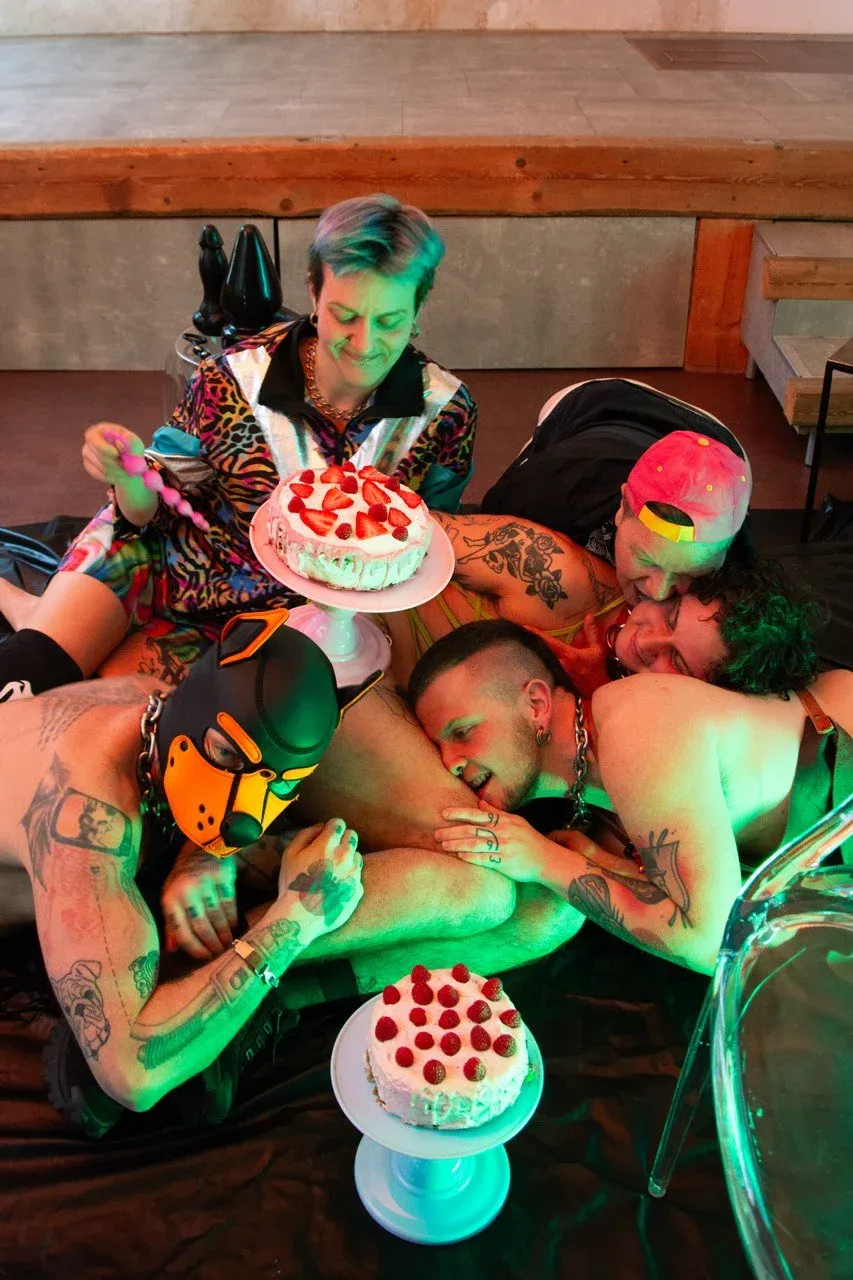
More Than Pleasure: How Queer BDSM Spaces Practice Social Justice
What if desire, power, and community could be imagined in entirely new ways? That is exactly what happens in queer BDSM spaces. In a society that dictates how bodies, relationships, and desire are “supposed” to be, these spaces do not simply question norms. They actively reshape them.
Queer BDSM spaces are far more than places for sexuality. They create opportunities to renegotiate togetherness, consent, and power. In doing so, they make social justice tangible in everyday life.
Alongside this, a new podcast episode is now available, created in collaboration with the feminist archive FFBIZ and BDSM Beyond Binary. In the episode, we talk about our research, experiences from the scene, and the political dimensions of queer BDSM practices.

Why These Spaces Are Political
Queer BDSM spaces are not only about individual preferences. They are places where fundamental questions are negotiated. Who is allowed to be visible? How can power be shaped? What does consent mean? And how do we want to relate to one another?
These questions remain neither abstract nor theoretical. They are lived in practice. This is where the political force of these spaces emerges. They demonstrate that social norms are neither neutral nor fixed.
In 2025, my colleague and I conducted ethnographic research on this topic in Berlin. It quickly became clear that queerness and BDSM are not separate fields. Instead, they form a shared space in which new forms of relationships, community, and agency can emerge.
Rethinking Desire
In these spaces, desire does not follow rigid social expectations. It develops through communication, trust, and consent. Rather than centering normative ideas, these spaces focus on lived experiences such as intimacy, intensity, control, surrender, or vulnerability.
One participant in our study described how openly talking about boundaries was already a completely new experience for them. Through this, self-determination suddenly became concrete and tangible.
Our research also showed how experiences of queer hostility can be decoded and transformed through kink. Experiences of powerlessness can become agency, creativity, and empowerment. In this sense, BDSM becomes not only a practice of desire, but also a way to reinterpret and process social experiences differently.
A blog article titled “Spit Politics: Desire, Power and Queer Agency” is expected to be published here in June.
This is precisely where the political dimension of these spaces becomes visible. Desire does not have to follow the images and rules imposed by society.

Community Instead of Assimilation
Queer BDSM spaces are not isolated niches. They are places of collective negotiation where people experiment with new forms of togetherness.
Community is not created through assimilation, but through openness, communication, and mutual recognition. Many people experience these spaces as an alternative to a society in which certain bodies and identities are excluded or rendered invisible.
Reclaiming the Body
One of the central findings of our study was that bodies that are often socially marginalized are perceived differently in these spaces. Trans*, non-binary, asexual, disabled, and neurodivergent people experience visibility, recognition, and desire.
Power is also understood differently here. It is not treated as something naturally given, but as something that is openly communicated, reflected upon, and collectively shaped. Consent is not a side issue. It forms the foundation of interaction.
Social Justice in Everyday Life
Our conversations show that social justice in these spaces is not understood merely as an abstract political goal. It emerges through concrete practices. This becomes visible in respectful interactions, in the negotiation of boundaries, and in the conscious handling of power.
Many of the people we spoke with described BDSM as empowering. These spaces help them process experiences of exclusion and develop new possibilities for action.
Conclusion: Change Is Already Happening
Queer BDSM spaces are not marginal phenomena. They are places where alternative ways of living together are made visible and actively explored. They create more open, self-determined, and just possibilities for community.
These spaces are neither free of contradictions nor perfect. Yet their openness to negotiation and transformation is exactly what makes them spaces of social change.
The question, then, is not whether these spaces are political. The real question is what we can learn from them.