Documenting leather subculture - BDSM is more than a porn category
Consensual sadomasochism has had a rich, erotically-charged history. While tales of sadomasochistic sex go back to ancient times, much of what we call BDSM today can be connected to the leather movement, a gay subculture which emerged in major U.S. cities during the post-WWII period. Early leathermen were mostly veterans of the war, and they formed the first BDSM-oriented leather clubs and biker clubs in the United States.
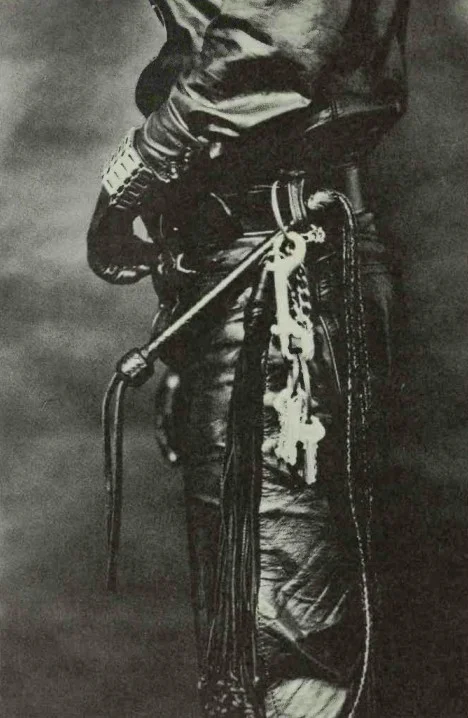
These clubs contributed significantly to the aesthetics we associate with BDSM: heavy leather, chains and whips. But beyond these aesthetics, they also described and gave detailed guides for BDSM play. They published the first major manuals on BDSM practice, such as The Leatherman’s Handbook, in 1972, which described how to stage an S/M scene and negotiate a power play dynamic with a partner.
Over time, leather scenes grew and evolved, and women began forming their own clubs. The first lesbian leather organization, Samois, was established in San Francisco in 1978. Rejected by the lesbian women’s movement due to their interest in S/M, the members of Samois protested their exclusion and advocated for a feminist stance in support of greater sexual freedoms in consensual relationships.
While Samois disbanded in 1983, the legacy of their writing has continued to influence BDSM practitioners across different scenes and subcultures. Their interest in both the art of consensual S/M and the political situation from which they wrote make their work and contributions unique and valuable to discussions about BDSM and sexual politics today.
The feminist sex wars
Samois had a lot going against them. Not only was the beginning of the Regan-era in the U.S. bringing forth the national promotion of traditional values at the expense of gay and lesbian communities, but the larger lesbian-feminist community had basically deemed consensual sadomasochistic sex to be the result of patriarchal brainwashing, and even a form of rape. With little support from both other lesbian groups and society at large, they took to activism and writing to advocate for the practice of S/M. This time in history, which follows the emergence of sex-positive feminism, is known as the feminist sex wars.
In 1981, Samois released the anthology “Coming to Power”, the foundational text of the lesbian-feminist S/M movement. What is particular in Samois’s writing is the way in which sexual roles are de-essentialized: rather than reflecting a person’s biological sex or inherent “natural” state, they focus instead on a fantasy (perhaps a very hot one) that can be played with and directed in various ways. The protagonists in Samois’s erotic stories are not flattened caricatures but complex, desiring subjects, and capable of multiplicity. They are vulnerable tops whose self-reflections nonetheless do not keep them from action, bottoms who know what they want and how to make their partner want to give it to them, curious newbies who can overcome their judgements to try something strange and beautiful.
For many members of the women’s movement, Samois was a stain. The existence of a lesbian sadomasochistic society threatened to repudiate the idea held by certain feminists that power dynamics, hierarchies and violence were inherent only to men. While other members of the women’s movement were critical of this ideology, recognizing women’s potential for contributing to injustice, most were simply not familiar enough with consensual S/M and the ways it differs from manipulation and abuse to avoid conflating them. It’s a lot easier to hate without listening.
What Samois’s feminist S/M demonstrates, however, is that one does not necessarily need to choose between one’s fantasies and a relationship based in mutual respect for each individual’s autonomy. With some imagination, you can make your fantasies work for you.
BDSM and sexual politics today
While BDSM has become more mainstream in recent years, sexual conservatism is on the rise. Discussions about feminism, consent, pornography and sex work are again in focus, and harmful policies such as the Nordic Model are being leveraged by those seeking an easy, moralistic political gain. Perhaps the struggles from leather subculture’s history can inform us about what we can do better today.
Being part of a BDSM scene, engaging in conversations with other practitioners, and exchanging knowledge and skills changes the options that we have. Many of us were not given comprehensive sex education (if any) in the schools where we grew up, and have had to learn from our own experiences and our partners. Spaces for education, and in particular in-person spaces, are vital to the development of a responsible and risk-aware S/M practice.
Beyond what we can learn ourselves, it is important to document our work for future generations as this sexual knowledge is at risk of being forgotten. It’s terribly convenient to demonize S/M and sex work, and thus to discard the experiences and stories we have gathered. Proponents of a white-washed feminism, politicians proclaiming social order and daydreamers of utopian fantasies will try to erase whatever lingers too disquietingly in the way of their dreams of purity. It’s through education, exchange, and sharing our experiences that we can act, so as not to let them.