
After “Cherry on Top”, it may be worth looking at what lies underneath: the messy, contradictory, and not entirely resolvable aspects of intimacy. Few things reveal this as clearly as spit.
Spit is never neutral. It is both banal and charged, ordinary and tabooed at the same time. It belongs to kissing, desire, and language, yet often turns into something perceived as disgusting precisely at the moment it becomes visible. As a glossy layer on skin, as a string between mouths, as something warm that suddenly no longer dissolves into the moment but becomes perceptible as substance. In that instant, perception shifts toward something that is quickly read as too close, too much, or no longer private enough. Spit both marks and crosses that boundary.
Within queer contexts, another layer emerges. Spit resists the idea of clean, controlled, and normalized bodies. For many people whose bodies are already read as too much, too visible, or somehow wrong, there is a peculiar form of reclamation in that. Not despite its rawness, but precisely because of it. Spit is not polished, and it does not need to be.
Socially, its meaning is clearly coded. Spitting is considered disrespectful; spitting on someone is associated with humiliation. It functions as a gesture of degradation, distancing, and power. At the same time, spit repeatedly appears wherever physicality is being performed or emphasized — in rituals, in language, or in gestures of belonging. It constantly oscillates between these meanings.
This ambivalence becomes especially tangible when spit crosses boundaries: between inside and outside, between bodies. In kissing, it usually remains invisible and unquestioned. The moment it is made visible, something shifts. Intimacy becomes more concrete, more tangible, and harder to ignore.

Perhaps spit can also be understood differently here. Not merely as a transgression of boundaries, but as something that resists fixed categories altogether. It is neither clearly inside nor outside, neither entirely me nor entirely you. It moves between bodies, connects them, and momentarily dissolves their separation.
In this sense, spit becomes almost non-binary. Not as an identity, but as a bodily experience — a state of in-betweenness that cannot be clearly defined. Spit is transition rather than condition.
This in-betweenness has a long cultural resonance. Liquids often mark precisely these kinds of thresholds. In mythology, for example, the River Styx separates the world of the living from that of the dead while simultaneously connecting them. It is both boundary and passage. Meaning emerges here not through clear separation, but through what flows in between.
Spit functions in a similar way. It is not a stable object, but something fluid that spreads, mixes, and transforms. And perhaps this is where its queer quality lies: not in being fixed or easily categorized, but in creating relation where separation once existed.
Maybe this is also why spit is so difficult to control. It resists aestheticization. It cannot be fully staged, polished, or smoothed over. It is visible, bodily, immediate. It refuses distance and pulls bodies closer together.
At this point, queer perspectives shift the question itself. Not what spit means, but who gets to define that meaning. Categories such as purity and impurity, disgust and desire, are never neutral. They are historically constructed, socially regulated, and politically charged. Spit exposes these structures precisely because it never fully submits to them.
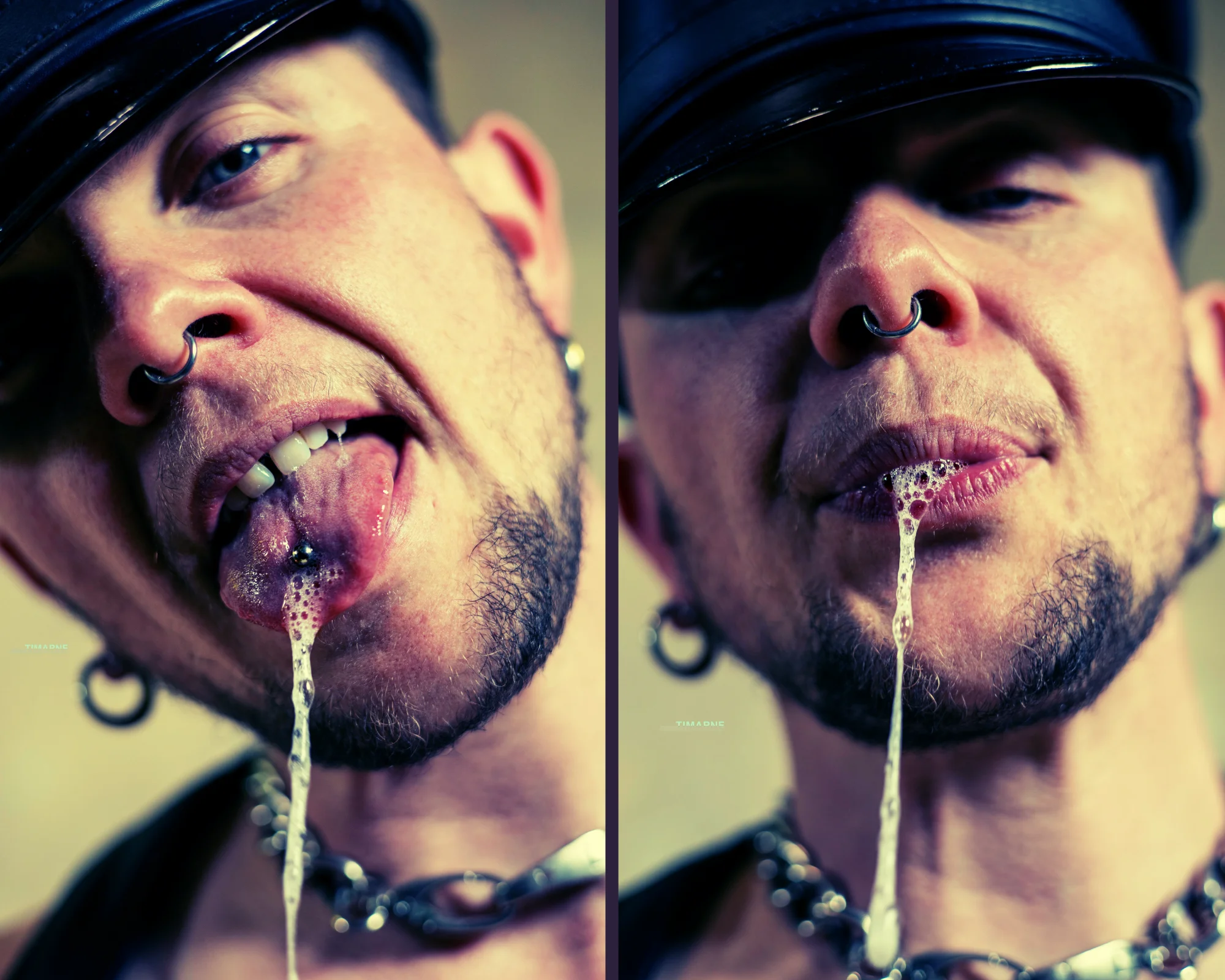
Within BDSM, this instability is not resolved, but actively used. Meanings are negotiated. Spit becomes more than a practice – it becomes a relationship between control and surrender, between play and seriousness, between intimacy and power.
Precisely because spit carries such strong social associations, it requires negotiation. Consent is not an addition, but a prerequisite. Communication, trust, and care form the foundation. Intimacy does not emerge automatically; it is created.
Spit is difficult to distance oneself from. It feels more immediate than many other practices. There is no clear filter, no complete performance, no way to fully aestheticize it. Bringing spit into a scene also brings vulnerability to the surface. It becomes visible, tangible, difficult to conceal.
For many queer people, this is not accidental. Experiences of shame, degradation, or being made to feel like too much do not simply disappear. But they can be shifted — into a context that holds them, into a dynamic that is chosen rather than imposed.
This does not automatically turn a gesture of humiliation into empowerment. But it creates the possibility for that transformation.
Spit is less unambiguous than it may appear from the outside. It can express dominance or trust — and often both at the same time. It can create distance or intimacy. It can wound or connect. What matters is not the gesture itself, but the relationship in which it takes place.
Perhaps spit can therefore also be understood as a kind of language. A language that is not spoken, but created between bodies — through eye contact, timing, tension, and consent. It has no fixed meaning, yet it produces very real effects.
And perhaps this is also where its non-binary quality lies. Not in a clear statement, but in the in-between. In what resists fixed categorization. In what flows.
Queer spaces make exactly this possible. Meanings are not fixed, but shifted. Not everything is reinterpreted, but much becomes newly legible.
Not every scene involving spit play is political. But every scene carries the possibility of becoming political.