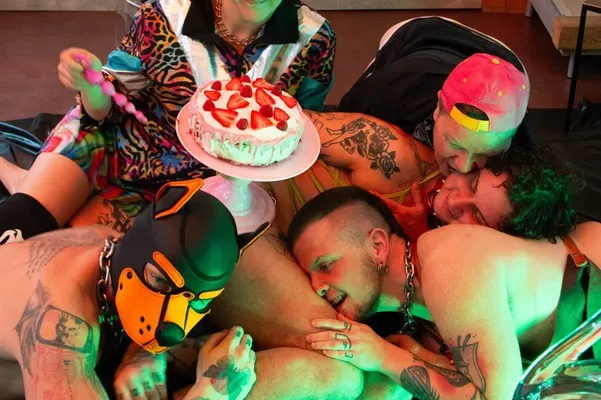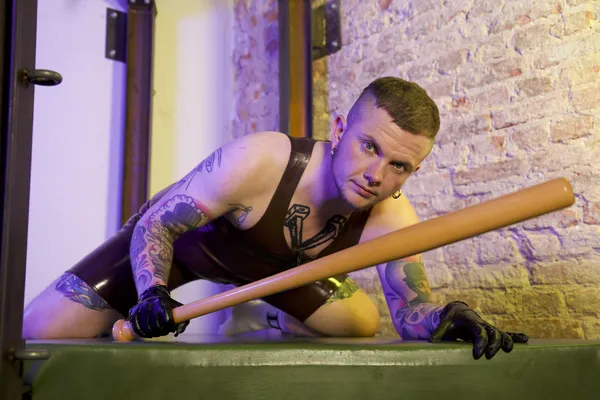
I’m writing this from within my work: from sessions, messages, and conversations with clients, colleagues, friends, and people I love and admire; from the small and sometimes fragile spaces where something begins to shift.
As a queer transmasculine BDSM dominus, I move through an industry that was not built with me or many of the people I care about in mind. And yet, I also witness moments where things open up: where clients feel addressed for the first time, where desires become speakable, where bodies that were never meant to be central suddenly are.
This text emerges from that tension. From frustration, anger, and repetition, but also from curiosity, connection, and the quiet, stubborn joy of imagining and creating something different.
It’s not a neutral analysis. It’s a situated perspective, shaped by my position, my work, and the people around me. A rant, maybe. But also a collection of moments where, sometimes, joy and love insist on being there.

Sex work is work and work is never neutral
Much of sex work activism focuses on normalizing sex work as work and rightly so, because even this basic premise is still not widely recognized. I feel that in everyday conversations, in how people react when I name what I do, in the hesitation, the distancing. Comments like “but you don’t have to do that, right?” often come up quickly. So yes, this matters. Sex work is work.
At the same time, work under current conditions is never neutral. It is embedded in capitalist systems and shaped by existing power structures. Sex work is no exception it is labor within a market, influenced by the same dynamics of inequality, demand, and access as any other sector, just far more heavily stigmatized.
I notice this very concretely in my own practice: in the kinds of requests I (don’t) receive, the expectations clients bring, and who feels entitled to book me in the first place. Sometimes it shows up in messages that begin with hesitation: “I’m not sure if I’m even your typical client…” or “I hope this is okay to ask…” – small disclaimers that already signal who feels addressed by sex work, and who doesn’t.
When sex work is singled out for moral condemnation, while the broader structures of wage labor remain unquestioned, something feels off. If the concern is exploitation, then it has to apply to labor as a whole. Otherwise, what I encounter again and again is less a structural critique and more a discomfort projected specifically onto sex workers – especially onto those of us who are already marginalized.
And this is not abstract. It shows up in the conditions people work under: in police raids where sex workers – particularly migrant workers, trans people, lower class hookers, Black workers and workers of color – are treated as suspects rather than workers; in situations where workers report violence and are not believed, or are themselves criminalized; in brothel inspections where people, fearing fines, registration checks, or deportation, try to hide or leave quickly, sometimes putting themselves at even greater risk.
These are not isolated experiences. They are reflected in what sex worker collectives and organizations have been saying for years: that criminalization and policing do not make workers safer, but more vulnerable.
From where I stand, a worker-centered approach would look very different. It would mean access to healthcare without stigma, enforceable labor protections, the ability to organize, safer working conditions, and support systems that are actually accessible. It would mean fewer barriers, not more.
Because, again and again, this is what becomes clear:
Sex workers don’t need rescuing. Sex workers need rights.

Norms shape who is seen and who feels addressed
The erotic industry reflects the same structural inequalities we see everywhere else: patriarchal, classist, racist, cis- and heteronormative, and ableist. There is a very clear idea of who the “default client” is supposed to be, and it’s not queer people, not trans people, not disabled people, and not people who deviate from normative beauty standards. The same is true for the image of the “default service provider".

This plays out on two levels: who is imagined as a client and who is able to exist sustainably as a worker.
On the client side, I’ve had many conversations with queers who tell me they never even considered booking sex work before. Not because they weren’t interested but because nothing in the industry suggested that it was for them.
I recognize that in myself too. Before I entered this field, I also didn’t see myself reflected anywhere neither as a client, nor as a provider.
That’s why unlearning normative marketing logics has become an ongoing part of my own practice. When I look at typical erotic advertising, I see the same images, the same phrases, the same bodies and roles, the same assumptions repeated over and over again. I’m still learning how to do things differently in my own work.
I explicitly address queer clients. I name them, us. I don’t treat queers as an exception.
And I try to communicate something very simple, but often missing:
You don’t have to look a certain way.
You don’t have to perform in a certain way.
We don’t have to follow a script.
I’ve had sessions where people were surprised that we could just… stop. Take a break. Talk. Renegotiate. One client once told me, almost apologetically, that they didn’t know if they were “doing it right.” That moment stayed with me. It showed how deeply people internalize these normative expectations, especially in a space that is supposed to be intimate and exploratory. Another one asked me, halfway through a session:
“Is it okay if we slow down?”
– a question that reflects how deeply we have learned to prioritize performance over our own needs.
For many people, even very basic sounding questions can already feel like a completely new (sexual) experience. For example, I ask clients how they would like me to refer to them, their body, or specific body parts, what language feels affirming, what feels neutral, and if there is anything that is off-limits.
I ask which terms or dynamics feel good to them and which ones are connected to discomfort or dysphoria. We talk about boundaries, about pacing, about what kind of touch or interaction feels safe(r), and what should be avoided.
I’ve had clients pause and say they had never been asked these questions before, that no one had ever explicitly invited them to define the terms of their own experience in that way. For some, just being given that space to articulate preferences, to set limits, or to change their mind during a session already shifts something fundamental. It opens up the possibility that intimacy and sexuality can be co-created, negotiated, and responsive.

This is not about selling perfection or getting everything “right”, but about normalizing difference.
We cannot read each other’s minds, and experiences of intimacy are always specific – shaped by positioning, biography, trauma, body, individual needs, and the particular constellation of people, time, and space. It also means acknowledging that things don’t always go as planned: misunderstandings happen, something might not feel good, boundaries can shift in the moment.
For me, this also includes moving away from a capitalist competition mindset and instead leaning into exchange and accountability with colleagues and friends. Being able to say: Hey, how do you deal with this? Have you ever had a situation like that? How would you approach this differently? Creating space for sharing experiences, reflecting on mistakes, and learning from each other.
Rather than assuming what people need, I try to approach this as an ongoing practice: asking, listening, and adjusting. We don’t meet on neutral ground – our interactions are shaped by different privileges and experiences of discrimination. Creating safer(r) spaces, then, is not about guaranteeing safety, but about staying responsive to shifting needs, boundaries, and dynamics as they emerge.

What counts as “sex” is not neutral
Norms also shape what is even understood as “sex". I’ve lost count of how often I’ve seen “full service” defined in very narrow, cis-heteronormative terms – always centered around girl dick/ penis-in-vagina/ front hole/ boy pussy penetration. It implies that any session without this particular act is not “full,” no matter how broad, intimate, or skillful the spectrum of services offered may be.
I’ve had moments even before sessions, in initial inquiries, where clients would almost apologetically ask whether what they were looking for even “counts” as something a sex worker would offer, often prefacing their messages with “This might sound weird, but…”. I find that question very revealing, not about the clients themselves, but about how narrow and prescriptive dominant ideas of sex and intimacy still are.
Maybe the more interesting question, then, is not what counts as sex, but who gets to define it and for whom. Letting go of fixed definitions can open up a much wider field of possibilities: where intimacy is not measured against a checklist, but shaped by curiosity, communication, and the specific desires of the people involved.
In that sense, “full” stops being about a single act and becomes something relational, something that can look radically different from one encounter to the next.

Material realities: tools, spaces, representation
The same normativity shows up in very practical ways. When I first started working in different professional spaces, I noticed how limited the equipment often is. Multiple chastity devices for penises/ girl dicks but little to nothing for other genital configurations. Similarly, play with gender expression is predominantly framed and marketed as feminization, leaving far less space for those who already embody femininity and want to explore their gender (expression) in other directions. Androgynous expressions and transgender identities are rarely, if ever, explicitly acknowledged.
So I started to build my own setup differently. I invested in toys and equipment that work with different bodies, in protection like dental dams, in tools that allow for more varied forms of play. Not because it’s “extra,” but because it should be basic. I also make a conscious effort to represent different possibilities in my work – whether that’s through images, descriptions, or how I talk about sessions. I don’t see this as something I’ve achieved, but as an ongoing practice of learning, unlearning, and listening.
I want people to be able to imagine themselves there.

And I see how powerful that can be. I’ve had queer clients tell me that simply seeing an openly transmasculine BDSM dominus shifted something for them, that it made a fantasy feel possible, or legitimate.
I think, too, of all my sex worker friends who embody that same shift: queer, neurodivergent, BIPoC, hairy, scarred, asymmetric, deviant, disabled bodies – unapologetically present, not asking for approval. Being the service providers that many clients actually need.
Opening space for desire
A big part of my work is not just offering services, but opening up imaginative space.
Many of my clients come in with desires that feel vague, or even inaccessible to them. Things that don’t fit into existing categories. Sometimes these things have been suppressed for years because they didn’t align with normative ideas of gender and/ or sexuality. I’ve had people say things like, “I don’t even know how to describe what I want,” or “I’ve never said this out loud before.” Others start with, “This might not make sense…” or “I’m not sure if this is even a thing.”
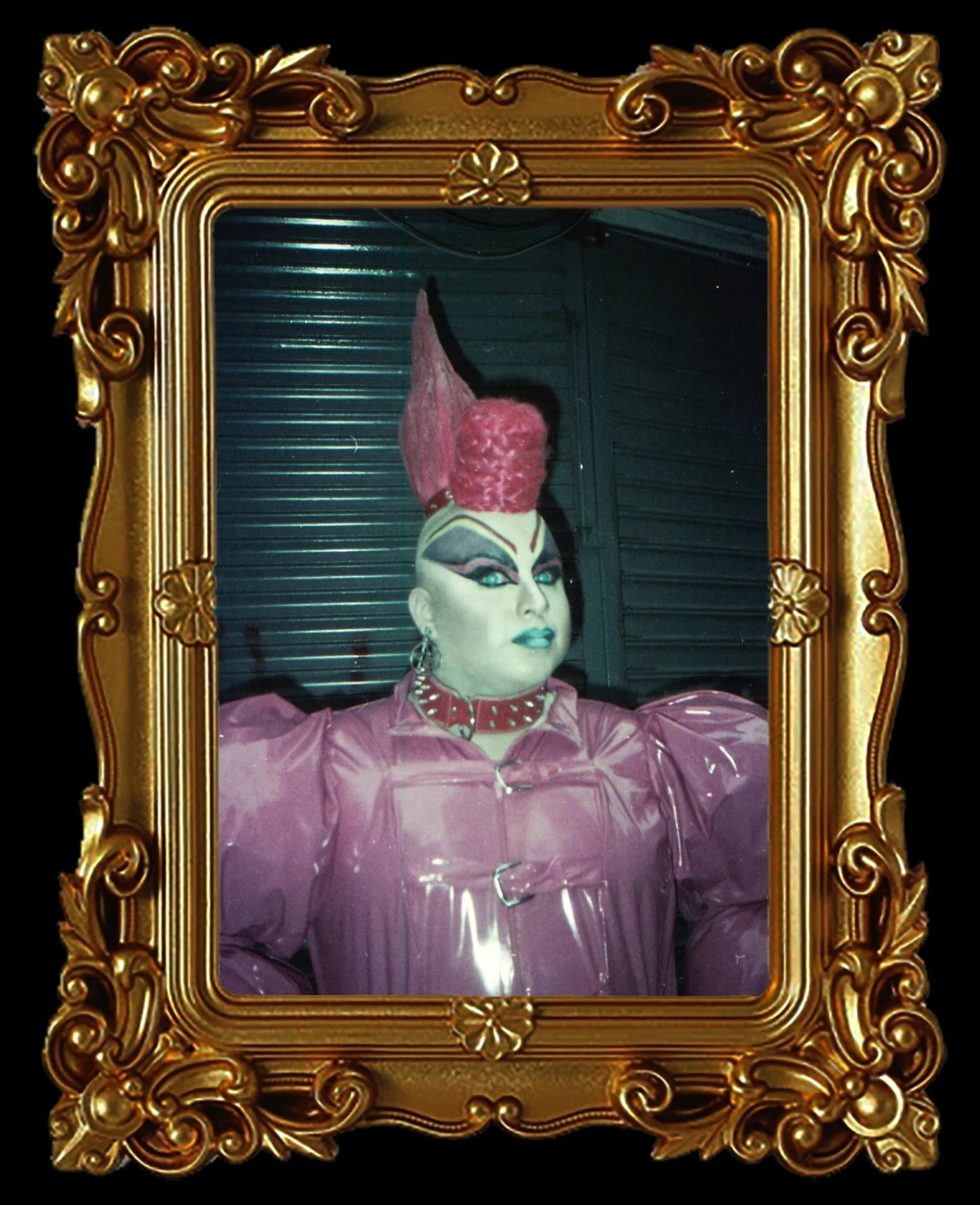
Often, it’s less about a clearly defined request and more about a feeling, a direction, or a question. And part of the process is staying with that uncertainty long enough for something to take shape. I don’t see my role as defining those desires, but as holding space for them to emerge.
Sometimes that means offering language. Sometimes it means slowing down. Sometimes it means saying:
We don’t have to know exactly what this is yet.
And often, it means gently pushing against internalized shame.
Inequality among workers
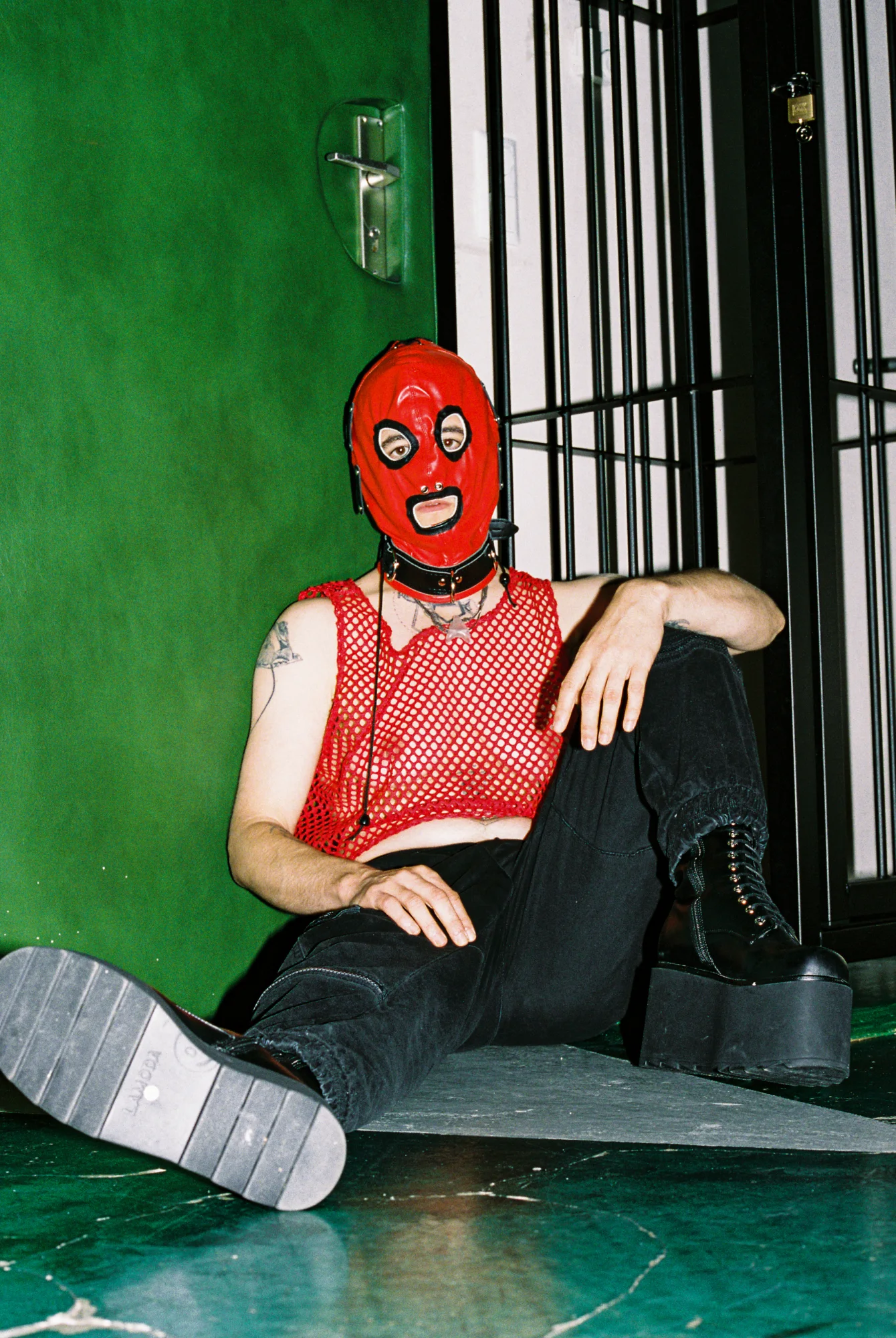
On the other hand, on the provider side, social norms shape different but closely connected aspects of sex work: how pricing is negotiated, whose bodies are presumed desirable or competent, who has to work significantly harder for visibility and recognition, how bodies are fetishized, how sex workers navigate and sometimes make use of that fetishization, and what kinds of shifts might still be possible.
First, social norms shape who is able to charge what. Whose services and bodies are expected to be available at lower rates, and for whom clients are willing to pay several hundred or even thousand euros without hesitation. Pricing is, of course, not neutral, but reflects the same hierarchies of desirability, normativity, and power that structure the industry as a whole.
Some providers are perceived as the “ideal” dominatrix or dominus simply because of their body or gender presentation. Their rates and expertise are therefore less likely to be questioned. Others have to prove their competence and value over and over again and are consequently much more likely to face attempts to negotiate their rates or doubts about their professionalism:
“I’ve seen others offer this cheaper…”

The fact that many sex workers are not registered, cannot risk legal trouble, or are in unstable residency or citizenship situations often makes them more vulnerable to being taken advantage of in negotiations around boundaries, conditions, or pricing.
Second, these same social norms shape how bodies and identities are fetishized. Within these broader structures, I also experience this very directly in my own work. As a transmasculine dominus, I am often not read as what I actually offer. I get requests that reduce me to a trans fetish, rather than recognizing my BDSM skills. Messages from cis-people like “I really like transmasculine people” or “I also had a trans boyfriend once” are often meant as a form of reassurance, but tend to center my identity rather than my work.

This dynamic is not unique to me. The same pattern extends to colleagues and friends who are BIPoC or have physical disabilities, whose work is also frequently filtered through stereotypes and fetishization rather than being recognized in its full complexity and competence.
Third, I want to emphasize that there is also agency in how sex workers navigate these dynamics. It can be a valid and strategic choice to make use of what one is fetishized for and to monetize it on one’s own terms. The issue is not that these dynamics exist, but that they often become the dominant or only lens through which people are seen and approached.
At this point, I can only recommend silicone pussy’s film You Are Not a Regular, which portrays migrant sex workers’ lived realities in Berlin.
Finally, despite all of this, I also see shifts happening. More queer clients are reaching out – sometimes saying “I’ve been looking for someone like you” or “I finally feel addressed.” More non-normative providers are becoming visible on their own terms. My own client base has shifted over time and that gives me a lot of hope and joy.
What I want to see
Sex work is work – always.
It is work within an industry that is still heavily structured around cis and heterosexual male desire.
From where I stand, I want something different.
I want more queer clients.
I want access to erotic services to be less determined by structural inequality.
I want erotic spaces where queer, trans, and other marginalized people are not treated as exceptions but are part of the assumed audience.
I want an industry that does not simply include marginalized people as niches, but fundamentally transforms its norms, aesthetics, and power structures.
I want toys and studio equipment that reflect the diversity of bodies instead of catering to a narrow range of normative anatomies.
I want a broader range of gender expressions and body-gender combinations represented in porn, advertising, and media.
I want service providers to be recognized for their skills and the service they actually offer, rather than being reduced to identity based fetish categories.
I want more honest conversations – within sex work circles and beyond – about our own privileges, positionalities, and responsibilities, where we genuinely (learn to) listen to one another instead of turning conversations into a competition over victimhood.
I want us to remember that we are stronger together. I want us to build relationships of solidarity that can survive disagreement, to work through conflicts instead of immediately giving up on or canceling one another.
And I want us to stop judging ourselves and each other for taking breaks, finding joy, and caring for our well being and recharging. We all carry different structural burdens, many of which are not visible from the outside. We have been shaped by different experiences and trauma, have access to different resources and capacities. Our struggles must be sustainable, and they can only be if we stop burning ourselves and one another out.